CalculiX structural bracket simulation
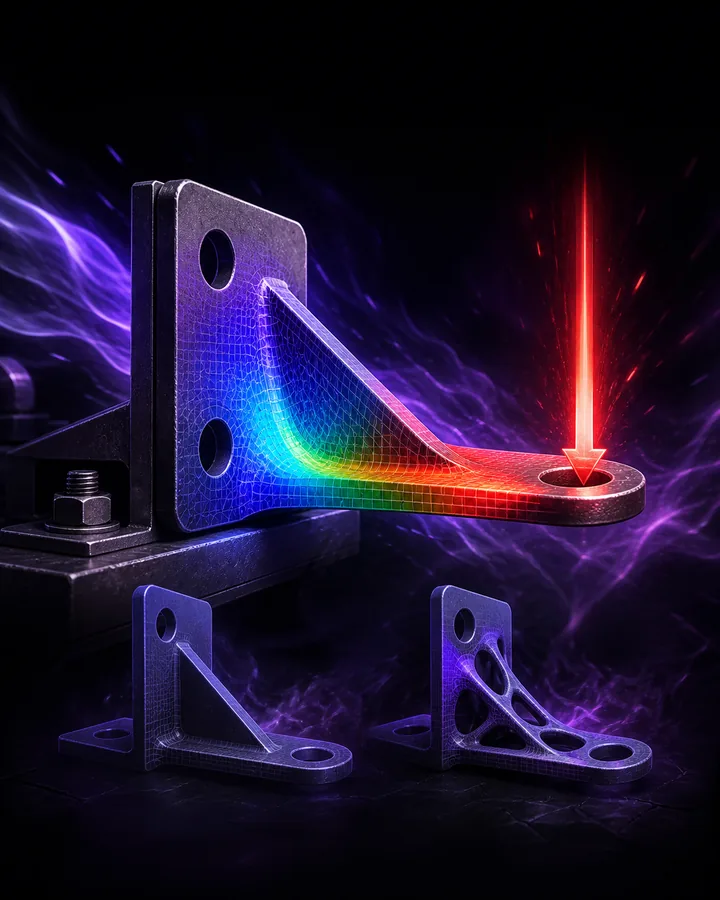
A CalculiX 2.23 finite-element study of a steel mounting bracket under a 300 N end load, including mesh convergence and two reinforced designs.
Software compatibility
The solver, input decks, and reference results use the pinned CalculiX 2.23 environment. Abaqus, ANSYS Mechanical, Nastran, and SolidWorks Simulation project files are not included.
Project definition
Problem statement
Bracket stress depends on geometry, load introduction, supports, contacts, material assumptions, element type, mesh, and stress concentration interpretation.
Project objectives
- Generate a conforming C3D8I hexahedral model of a steel L-bracket.
- Calculate displacement, reactions, and von Mises stress under a 300 N end load.
- Demonstrate displacement convergence using 4 mm, 2 mm, and 1 mm baseline meshes.
- Compare a uniformly thickened bracket with a centrally ribbed bracket.
- Verify force equilibrium and compare the response with a cantilever-beam calculation.
Project structure
Project components
Geometry and mesh
Generates baseline, thickened, and ribbed bracket solids with shared nodes, named sets, and controlled mesh sizes.
CalculiX model
Defines linear-elastic steel, C3D8I elements, the fixed face, distributed end load, and solver output.
Result parser
Reads CalculiX output and calculates displacement, reactions, assessment stress, percentiles, mass, and balance.
Convergence study
Compares the 4 mm, 2 mm, and 1 mm baseline meshes under the same physical model.
Design comparison
Evaluates baseline, 8 mm thickened, and 6 mm central-rib designs under identical loading.
Methodology
Project workflow
- 01Generate
The selected case creates a fresh input deck and mesh metadata.
- 02Solve
The pinned CalculiX 2.23 container completes the linear static analysis.
- 03Parse
Python extracts numerical results and writes a structured JSON summary.
- 04Verify
Tests check volume, connectivity, load sum, stress reduction, equilibrium, and analytical formulas.
- 05Compare
Tables and plots present convergence and design performance.
Demonstration scenario
A 100 mm steel mounting bracket under a 300 N end load is solved on three baseline meshes. The verified study then compares an 8 mm thickened design and a centrally ribbed design for displacement, mass, and stress.
Engineering
Tools and method
- Tools
- The project uses CalculiX 2.23, Python, Gmsh 4.15.2 optional, ParaView optional, Jupyter, Matplotlib for subject analysis, simulation, and results.
- Environment
- CalculiX 2.23 is compiled from its verified official source archive in a pinned Docker image.
- FE model
- A Python generator writes conforming C3D8I meshes, material data, loads, constraints, sets, and output requests.
- Post-processing
- Python parses DAT and FRD files and produces JSON, CSV, Markdown, SVG, and PNG results.
- Verification
- Reaction balance, a cantilever reference, unit tests, mesh refinement, and repository validation are included.
Testing
Evaluation
Evaluation measures
- Vertical force equilibrium
- Tip displacement comparison with a cantilever reference
- Medium-to-fine displacement change
- Maximum and 95th-percentile assessment stress
- Mass, stiffness, and stress comparison across three designs
- Explicit interpretation limits for idealised supports and local stress peaks
Project boundaries
- Only the pinned CalculiX model is delivered.
- The first scope uses documented linear elastic and small-deformation assumptions.
- Fatigue, fracture, plasticity, contact, manufacturing defects, and load uncertainty are excluded unless explicitly scoped.
- The result is not a certified mechanical design or proof of physical safety.
Included
- 01Generated C3D8I bracket meshes and five native CalculiX input decks
- 02Pinned source-built CalculiX 2.23 Docker environment
- 03Displacement, stress, reaction, convergence, and visualisation scripts
- 04Baseline, thickened, and ribbed reference cases with verified results
- 05Complete project files, models, calculations, and analysis material in a private GitHub repository
- 0678-page project documentation in PDF and editable Word formats
- 0714-page setup and usage guide
Project record
No information is collected on this page.
- Permanent project ID
- GP-ME-07GJYQ0
- Catalogued
- 22 Aug 2026
- Completed
- 22 Aug 2026
- Verified
- 22 Aug 2026
- Demonstration
- Included in repository
Handover
After purchase
- 01Payment is confirmed
The project is marked unavailable and cannot be purchased again.
- 02Repository access is granted
The buyer's submitted GitHub account receives access to the private repository.
- 03The purchase record is delivered
The certification sheet is prepared from the reviewed buyer details and sent privately by email.