RTL logic optimisation visualiser
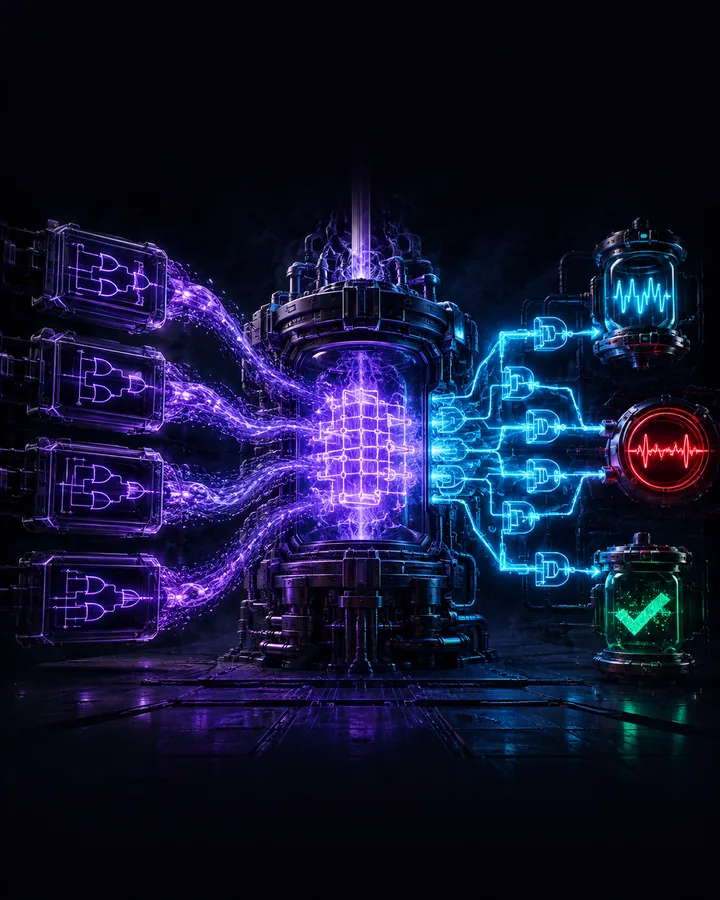
A completed digital-design study showing how open-source synthesis transforms four combinational Verilog designs while simulation and formal checks verify their behaviour.
Project definition
Problem statement
RTL simulation shows whether selected vectors produce expected outputs, but it does not explain how synthesis changes the logic network.
This project compares controlled baseline and optimised flows and verifies that structural changes preserve the prepared design behaviour.
Project objectives
- Synthesize four prepared combinational Verilog designs through two declared flows.
- Compare generic cell count, connected wire bits, cell-port connections, structural depth, and normalised cost.
- Generate readable netlist diagrams and retain the open JSON and Verilog netlists.
- Run self-checking simulations and formal equivalence for every design.
- Confirm that the verification flow rejects a deliberately faulty priority encoder.
Project structure
Project components
RTL designs
Redundant logic, priority encoder, multiplexer network, and 8-bit ALU modules.
Synthesis runner
Runs fixed Yosys baseline and optimised flows and retains every log and netlist.
Structural analyser
Calculates cell, wire, connection, depth, cost, and cell-family metrics from JSON netlists.
Netlist visualiser
Produces labelled Graphviz diagrams and paired PNG and SVG evidence.
Verification
Runs four test benches, four formal proofs, and one deliberate-fault check.
Methodology
Project workflow
- 01Compile
Icarus Verilog compiles and runs each self-checking test bench.
- 02Synthesize
Yosys produces baseline and optimised generic-cell netlists.
- 03Measure
Python reads the JSON netlists and calculates comparable structural metrics.
- 04Verify
Yosys proves each prepared design pair equivalent and rejects the faulty control.
- 05Review
The report connects retained figures, values, logs, and limitations.
Demonstration scenario
Run the complete study once, compare the baseline and optimised priority-encoder netlists, verify the 141-to-19 cell reduction, inspect the passing simulation and proof logs, and then confirm that the faulty encoder produces the expected formal failure.
Engineering
Tools and method
- Tools
- The project uses Verilog, Yosys, ABC, Icarus Verilog, Graphviz, Python, Jupyter, Matplotlib for subject analysis, simulation, and results.
- RTL
- Synthesizable combinational Verilog with deterministic self-checking test benches.
- Synthesis
- Yosys and ABC from OSS CAD Suite 2026-08-23.
- Simulation
- Icarus Verilog for 180,736 prepared vectors.
- Analysis
- Python and Graphviz for open metrics, tables, and netlist diagrams.
- Reproducibility
- A pinned multi-architecture Docker environment and one-command study runner.
Testing
Evaluation
Evaluation measures
- All 180,736 prepared simulation vectors pass
- Four original-to-optimised formal-equivalence proofs pass
- The deliberately faulty priority encoder is rejected
- Priority-encoder cells reduce from 141 to 19 and depth from 36 to 7
- ALU cells reduce from 415 to 221 and depth from 24 to 18
- Fourteen PNG and SVG result pairs are generated reproducibly
Project boundaries
- Generic cell count, structural depth, and normalised cost are comparison proxies.
- The study does not claim FPGA utilisation, silicon area, timing, power, or board measurements.
- The prepared first version covers combinational Verilog only.
- Equivalence applies to the checked source, assumptions, and pinned toolchain.
Included
- 01Four synthesizable Verilog designs and self-checking test benches
- 02Baseline and optimised JSON and Verilog netlists
- 03Fourteen result figures in PNG and SVG formats
- 04Simulation, synthesis, and formal-equivalence logs
- 05Complete project files, models, calculations, and analysis material in a private GitHub repository
- 0680-page project report in PDF and editable Word formats
- 079-page setup and usage guide
Project record
No information is collected on this page.
- Permanent project ID
- GP-EC-1NSM04T
- Catalogued
- 21 Aug 2026
- Completed
- 23 Aug 2026
- Verified
- 23 Aug 2026
- Demonstration
- Included in repository
Handover
After purchase
- 01Payment is confirmed
The project is marked unavailable and cannot be purchased again.
- 02Repository access is granted
The buyer's submitted GitHub account receives access to the private repository.
- 03The purchase record is delivered
The certification sheet is prepared from the reviewed buyer details and sent privately by email.